“HARNESSING ALGAE POWER FOR POLLUTION REDUCTION AND BLUE GROWTH” PROJECT
Odesa State Agrarian University is a partner of the international project within the Interreg NEXT Black Sea Basin Programme – “Harnessing Algae Power for Pollution Reduction and Blue Growth” (Project Acronym – AlgaeRevive, Project Code – BSB00091).
The project is co-financed by the European Union within the framework of the Interreg NEXT Black Sea Basin Programme.
The project unites partners from five countries – Romania, Bulgaria, Georgia, Greece and Ukraine – to jointly address shared challenges related to algal blooms and their impact on the marine ecosystem. The project aims to create a sustainable and innovative ecosystem for algae research, innovation and industrial implementation in the Black Sea region. It focuses on harnessing the potential of algae as a nature-based solution to reduce pollution, particularly in marine ecosystems and to explore their industrial applications across various sectors.
Main project activities include:
- Development of an AI-based algae monitoring tool called AlgaeSense.
- Mapping and monitoring of algal communities using artificial intelligence technologies.
- Pilot actions involving the identification and cultivation of algal species with industrial potential, as well as their introduction into selected marine areas to assess their effectiveness in nutrient reduction and eutrophication mitigation.
- These pilot actions will provide valuable insights into the feasibility of algae-based solutions for pollution reduction and their potential for industrial utilization.
Lead Partner –Via Pontica Foundation, Republic of Bulgaria
Project Partners:
- Prof. Dr. Assen Zlatarov University (UNIAZ), Republic of Bulgaria
- Tsotne Mirtskhulava Water Management Institute (WMIGTU), Georgia
- Odesa State Agrarian University (OSAU), Ukraine
- Hellenic Agricultural Organization DIMITRA (ELGO), Greek Republic
- Ovidius University of Constanța (OUC), Romania
Programme Priority: Blue and Smart Region
Project Duration: 30 months (September 2024 – March 2027)
Total Project Budget: €1 470 899,04
EU Contribution: €1 323 809,13
The project has a significant regional, national and cross-border impact.
Odesa State Agrarian University actively contributes to the implementation of this international initiative.
Participation in International Scientific Events
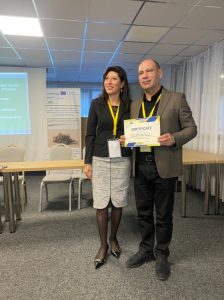
December 16-18, 2024, Burgas (Bulgaria)
The project manager from OSAU Professor Mykhailo Broshkov took part in the International Scientific Conference “The Black Sea – Scientific Approaches to Ecosystem Remediation and Innovation in the Blue Economy”, organized by Prof. Dr. Assen Zlatarov University.
The event was dedicated to current research and technologies in the field of marine ecosystem restoration.
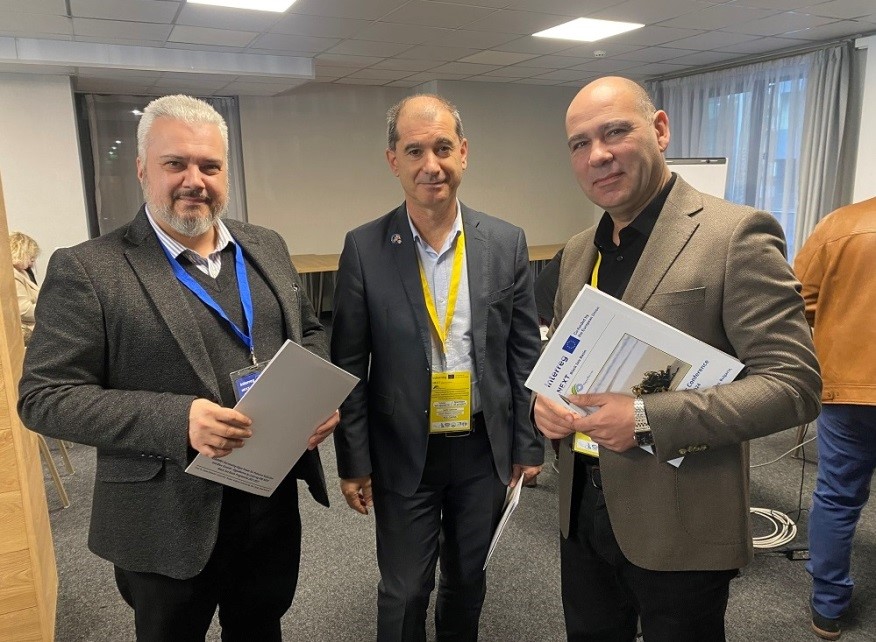
May 29–31, 2025, Constanța (Romania)
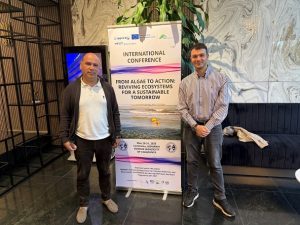
Odesa State Agrarian University, represented by the project manager Mykhailo Broshkov took part in the scientific event “From Algae to Action: Reviving Ecosystems for a Sustainable Tomorrow.” During the event OSAU presented the results of joint research on the use of humic substances as a biostimulant for microalgae.
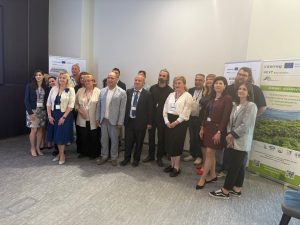
A meeting of project partners was also held. The key issues related to project implementation, reporting and achieving the objectives of AlgaeRevive were discussed.
Development of scientific infrastructure
Black Sea Algae Knowledge Center at OSAU
Within the framework of the project OSAU established the Black Sea Algae Knowledge Center, having modernized a research facility and acquired advanced laboratory equipment.
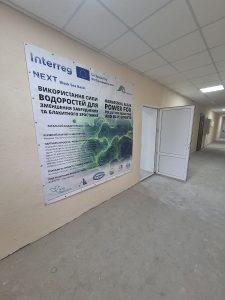
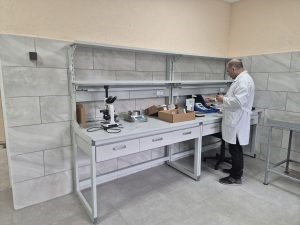
Research conducted within the Black Sea Algae Knowledge Center at OSAU
A series of scientific studies were carried out as part of the initiative “Establishment of the Black Sea Algae Knowledge Center.”
Water samples were collected from Lake Yalpuh for further analysis. When selecting sampling points, special attention was given to the algal species Cladophora glomerata, which determined the sites for material collection. Additionally, water sampling from the Black Sea was organized along the coast of Odesa.
The obtained samples are used to study algal diversity, assess water quality and create a database for the Center’s future research.
An experimental study was also conducted to examine the cultivation conditions of the microalgae Chlorella in artificial bioreactors, compared with natural water bodies of the region.